Revolutions Marine – Pensacola, FL | Boat Repairs and Maintenance
Run your hand across the topsides of a five-year-old boat that’s lived outdoors in Northwest Florida. If your palm comes away with a fine white powder, that’s not dirt. That’s your gelcoat breaking down.
UV exposure at this latitude, combined with constant salt spray and summer humidity, oxidizes the resin at the surface of the fiberglass. The pigment chalks. Gloss drops off. And once oxidation gets deep enough, no amount of washing brings it back — you’re into abrasive correction, which removes material you can never put back.
That’s the part most owners don’t realize until it’s expensive. Here’s how the work actually breaks down.
Washing Is Not Detailing
A wash removes salt, pollen and surface grime. It does nothing about the condition of the surface underneath.
Detailing is surface correction and protection — leveling out oxidation and defects, then sealing the result against the elements. The two jobs get lumped together in casual conversation and priced completely differently, which is why quotes across shops can look wildly inconsistent until you ask what’s actually included.
A useful rule for the Gulf Coast: wash after every saltwater trip, correct and protect on a schedule.
The Correction Ladder, From Least to Most Aggressive
Good detailers start at the gentlest step that will do the job. Each rung up removes more gelcoat.
One-step polish. For new or well-maintained boats. Light gloss enhancement and defect cleanup, then a protective layer. This is what you want to be doing before problems appear.
Heavy cut compounding. For real oxidation, fading and chalking. A cutting compound — Ardex Marine 1000 is a common professional choice — levels the degraded surface layer, followed by a finer polishing compound to refine out the haze the cut leaves behind.
Wet sanding. For boats that have been neglected for years. Typically 800–1000 grit, done only where needed, then compounded and polished back to gloss. This is the most aggressive option and the one where technician skill matters most — an inexperienced hand burns through gelcoat on a corner or a strake and you’re paying for fiberglass repair instead.
The honest version of this conversation is that gelcoat is finite. Every correction thins it. Protection is what stretches the interval between corrections.
Wax, Polymer or Ceramic?
Carnauba wax looks beautiful and lasts a couple of months in this climate. Fine for a boat that gets attention constantly.
Polymer sealants are synthetic, bond better, and typically hold up through a season.
Ceramic and SiO2 coatings form a semi-permanent hydrophobic layer. Water sheets off instead of beading and baking on, salt has less to grab, and UV resistance is dramatically better. Marine-grade ceramic can hold for up to about two years with far less upkeep than a wax cycle.
The economics usually favor ceramic on the Gulf Coast, but with one condition: it locks in whatever surface is underneath it. Coating over oxidation seals in a dull finish. Correction first, always.
The Half of Detailing Nobody Photographs
Exterior gloss is what shows up in the before-and-afters. The work that actually protects your resale value is less glamorous:
- Isinglass and clear vinyl — clouds permanently if cleaned with the wrong products or a dry cloth. Needs dedicated cleaner and a dedicated protectant.
- Vinyl upholstery — cracks from UV without conditioning, and grows mildew fast in a closed cabin through a Panhandle summer.
- Teak — cleaning and restoration, done correctly, without scrubbing away the soft grain.
- Brightwork — stainless and aluminum polish, before pitting sets in permanently.
- Rust and stain removal — those weeping streaks under fittings, and waterline staining from tannins and dock scum.
- Bilge cleaning, head cleaning, carpet, cabin and engine room detailing — where mold, mildew and odor problems start.
- Mold removal — a genuine issue on any Gulf Coast boat that sits closed up.
- Windshield tinting — reduces cabin heat load and UV damage to everything inside.
A survey notes interior condition. So does a buyer.
What It Costs, and How to Compare Quotes
In the Pensacola market, boat washes commonly start around $10 per foot and full detail packages around $25 per foot, scaling with vessel size and condition.
When comparing bids, ask three questions:
- How many correction steps — and are they wet sanding, compounding, polishing, or just applying wax over the problem?
- What products, specifically? “Ceramic” ranges from a genuine coating to a spray-on that dies in six weeks.
- Is interior work included, or is the quote exterior only?
A cheap quote that skips correction and lays wax over chalked gelcoat looks great for about three weeks.
Who Handles This Work Locally
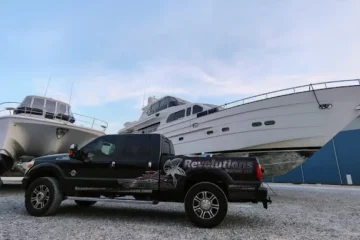
Revolutions Marine has been detailing boats and yachts on the Gulf Coast since 2012, with a team bringing over 20 years of combined marine experience. Licensed and insured, with an 83-review track record on Google and an accredited BBB profile.
Two things worth knowing about how they operate:
- They work mobile or in-house. The crew comes to you, on land or in the water, at any size vessel. For smaller trailerable boats they also run a 2,500 sq ft climate-controlled facility with professional lighting — which genuinely matters, because you cannot see fine swirl marks and holograms properly under a marina sun.
- Three tiered packages matched to condition rather than one-size-fits-all pricing: routine maintenance for well-kept boats, heavy cut compounding for boats needing extra attention, and full restoration with wet sanding for vessels that have been left too long. They use Ardex Marine 1000 for cutting, Starke Yacht Surface Technology waxes and polymers, and a house-formulated SiO2 polishing compound.
Every package includes topside and hull wash, chamois dry, glass and window cleaning, rust stain removal, brightwork polish and wax, vinyl conditioning and a hatch deep clean — so the baseline is a real detail, not a wash with a name on it.
Full package breakdowns and a project gallery are on their boat and yacht detailing page. Free estimates, typical response within an hour.
Revolutions Marine 40 Audusson Ave, Pensacola, FL 32507 (850) 619-7567 Monday–Saturday, 6am–6pm
Mobile detailing across the Panhandle: Pensacola Beach, Perdido Key, Gulf Breeze, Navarre, Fort Walton Beach, Mary Esther, Niceville, Destin, Grayton Beach and Seaside — plus Orange Beach, AL.
Frequently Asked Questions
How often does a boat need detailing on the Gulf Coast? Wash after every saltwater outing. A full detail with protection once or twice a year for most boats kept outdoors here — more often if the vessel is uncovered and unshaded.
Can oxidation be removed, or is the gelcoat ruined? Most oxidation is correctable. Compounding and polishing remove the degraded surface layer and restore color and gloss. Severe cases need wet sanding first. Only when gelcoat is worn through to the substrate does it become a fiberglass repair job.
Is ceramic coating worth it on a boat? In a salt and high-UV environment, usually yes. It lasts substantially longer than wax, sheds salt and water, and cuts maintenance labor. The condition is that correction has to happen first — coating locks in whatever’s underneath.
Can detailing be done in the water? Everything above the waterline, yes, and mobile crews do this routinely at your slip or lift. Bottom work is separate and requires a haul-out — that’s hull cleaning or bottom sandblasting, not detailing.
Does detailing help resale value? Materially. Gelcoat condition, upholstery and cabin cleanliness are the first things a buyer and a surveyor register, and correcting years of neglect right before listing costs far more than maintaining it would have.
See our other listings:
Boat Repair Pensacola
Boat Engine Repair Pensacola